


State-Mandated Retirement Plans - What Legislation Means for Business Owners & Executives
Articles Business OwnershipIn recent years, many states have introduced legislation requiring small businesses to provide employees with retirement benefits. Business owners and executives will have the additional responsibility of choosing a retirement plan that’s right for their business, meets their employees’ needs and is legally compliant.
State-mandated retirement legislation continues to evolve across the United States. Policymakers have introduced new laws that are designed to encourage more private-sector businesses to offer state retirement plans to their employees.
In jurisdictions with state-mandated retirement plans, eligible employers have a choice to enroll their employees in the states sponsored retirement plan program or provide retirement benefits on their own.
KEY FEATURES AND CONSIDERATIONS
COMMON PLAN TYPES
While a state-mandated retirement plan is typically thought of as a 401(k), it is more commonly a Roth IRA. This means that the employee contributions are taken from post-tax income.
ADMINISTRATIVE RESPONSIBILITIES
It’s vital for employers to consider the level of support they and their employees will need and want – including help with any initial setup, schedules, compliance, recordkeeping or other day-to-day administration tasks.
COMMON PLAN MECHANICS
State-mandated retirement plans are often administered through payroll deductions with automatic employee enrollment. That said, employees can opt out or change how much they contribute. Employers are almost always prohibited from contributing to the retirement plans.
PENALTIES
Business owners that fail to comply with state-mandated retirement plan legislation or miss enrollment deadlines may face monetary fines. Exact amounts vary between states.
STATE-TO-STATE DIFFERENCES
The inner workings, requirements and registration deadlines for statemandated retirement plans depend on the state in question. It’s essential to understand and identify the rules and regulations of individual states to make sure obligations are met.
THE MOVE TOWARD MANDATES
As of December 2025, 31 states have proposed retirement plan legislation, while 18 states have active mandated plans in place.
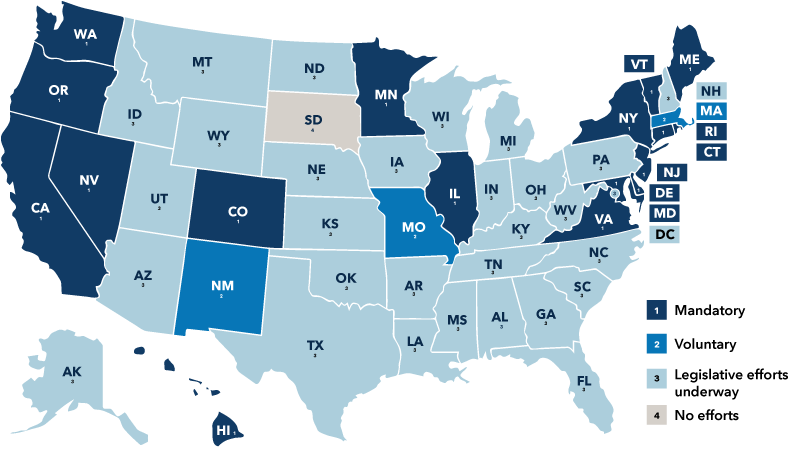
*Source: Capital Group, State-sponsored retirement plans and alternative options
SUPPORTING THE LONG-TERM FINANCIAL HEALTH OF YOUR EMPLOYEES
Without the time, support staff or knowledge necessary, the tasks surrounding state-mandated retirement plans can be daunting. Those same tasks are also unavoidable. With more than 49 states considering retirement plan legislation, there’s a prime opportunity for business owners to attract, retain and support their top talent. Now is the time to get ahead.
Along with Raymond James, we offer a variety of solutions that provide investment management, plan administration and recordkeeping services. As a business owner, you could benefit from having an advisor equipped with the tools to provide fiduciary support for plan sponsors and enhance the financial well-being of plan participants.
By offering your employees a retirement plan in a cost-effective and time-efficient manner, you make it possible for them to save and prepare for retirement – potentially differentiating your business as a competitive player in today’s job market.
Before your state’s enrollment deadline, let’s consider which retirement plans are right for your business.
I'D LIKE A COMPLIMENTARY REVIEW OF MY BUSINESS'S RETIREMENT PLAN OPTIONS
The information presented is for educational purposes only and not a recommendation of any specific product. All investments are subject to risk, including loss. There is no assurance that any investment strategy will be successful.